The Pic Saint-Loup
Plains, mountains, steep gorges, and small rivers promise beautiful discoveries and breathtaking panoramas for lovers of authenticity. Another idea for exploring the territory
Pic Saint-Loup: Wild and preserved.
At the gates of Montpellier, Pic Saint-Loup is the emblem of a territory that has managed to remain wild and maintain its share of mystery.
To better preserve itself probably, out of shyness perhaps or to respect its natural environment and its way of life for sure.
But if you take the time to tame it, it will reveal its hidden treasures, open the doors to an entire and sincere world, where human relationships and healthy living make up its daily life and history.


An extraordinary territory.
Located between the Mediterranean and the Cévennes, Grand Pic Saint-Loup offers a kaleidoscope of landscapes at the gates of Montpellier.
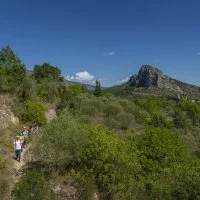
Plains, mountains, steep gorges, and small rivers promise beautiful discoveries and breathtaking panoramas for lovers of authenticity. On the road to adventure! 57 km² consisting of natural and agricultural spaces, highlighting the majestic Pic Saint-Loup, which rises to 658 meters facing the Causse de l'Hortus and the crests of the Séranne.
Prehistory and landscapes mix at the site of the Hortus cave or the Causse Rock, and everywhere, dolmens, dry stone walls, or huts, shape a landscape molded by man and marked by agropastoralism.
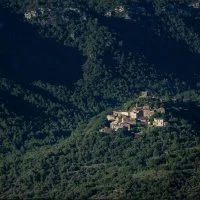
Set off to discover characterful villages with medieval architecture and enjoy the freshness of riverside paths, the shade of marked trails, or the softness of the sun on the vineyards. Treat yourself to a magical communion with nature.


The forces of nature.
If the silhouette of Pic Saint-Loup, identifiable among all, stands out in a hilly landscape to the point of becoming its emblem, it is because its formation is due to a specific geological phenomenon: the anticline fold.
About 140 million years ago, at the end of the Jurassic period, our beautiful country was submerged by an ancient sea called Tethys. Millions of years of marine sedimentation, partly derived from the accumulation of shells, will constitute the material that will become the limestone of our garrigues.
Two giants facing each other...
During the uplift of the Pyrenees chain, about 40 million years ago, this limestone was pushed up over dozens of kilometers. Sliding along the Saint-Gély – Corconne fault, the layers of limestone will fold and rise, until they form Pic Saint-Loup and its articulated silhouette. The Hortus, facing it, has a different geological origin. It is a limestone plateau called Causse (a non-folded set); the limestones of the Hortus are dated from the Cretaceous, therefore more recent than those of Pic Saint-Loup.
These two landforms facing each other thus do not share a common geological origin. The space separating them is merely a consequence of the erosion of sedimentary layers that are softer than limestone.