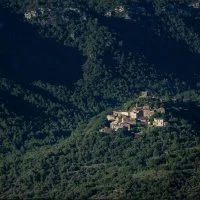
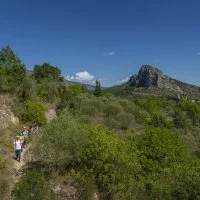
Cambous Site
Return to the past with a journey through time at the Cambous site. The stroll through the heart of the 2 hectares of scrubland of the prehistoric village built at the end of the Neolithic
One of the oldest villages in France
The site of Cambous enlightens us about a pivotal time in our history. At the end of prehistory, a profound mutation begins, with the transition from a lifestyle based on hunting and gathering to agriculture and livestock farming.
These new agro-pastoral activities will lead to a sedentarization that will be accompanied by numerous technical innovations. It is this history that the village of Cambous tells, and it is also a bit the history of the Grand Pic Saint-Loup.


A remarkable state of conservation.
Here, and nowhere else, a fossilized territory has crossed almost five millennia to offer itself to the always astonished gaze of the researcher or visitor.
Its remarkable state of conservation is due to its construction technique: unlike the Neolithic houses built in most regions of France, Cambous is not made of clay and wood, perishable materials, but of dry stone.
Four groups of eight to ten huts each have been discovered since 1967. The contiguous dwellings have thick stone walls and roofs according to an elongated plan with absidial ends: this architecture is typical of the populations of Fontbouisse.
One dwelling, with a stone and thatch roof, has been reconstructed on the periphery of the site.

An archaeological treasure
It dates back to the Chalcolithic (or Copper Age), a period between 2700 and 2300 BC. During these four centuries, a brilliant culture known as Fontbouisse will flourish, named after a site in the Sommières region (Gard) where similar remains were studied in the 1940s.
In the Garrigues (regions of limestone hills where garrigue grows) of Gard, Hérault, and Ardèche, the Fontbouisse people are the authors of countless dolmens and stone house villages. More than two hundred hamlets of this type are counted, but barely 20% have been studied by archaeologists. Much work remains, and the site of Cambous is there to testify to the interest of the research conducted in these regions.

A trip through time.
Constructed of stones, unlike most buildings of the time made of wood, it is considered one of the oldest visible villages in France. Equipped to receive visitors, including the reconstruction of a dwelling from the time, it is also a laboratory for studies and archaeological excavations.
It specializes in experimental archaeology, which consists of reproducing prehistoric gestures and know-how to better understand their evolution.

Current events


Hours
- From April 6 to July 7, then from August 31 to November 1:
Saturdays and Sundays from 2 PM to 6 PM - From July 7 to August 31:
From Wednesday to Sunday from 2 PM to 7 PM - From September 1 to October 31 from 2 PM to 6 PM on Saturdays and Sundays.
The site visit is done autonomously, following the explanatory rings. For groups and schools, guided tours are conducted by reservation throughout the year.
Price
- Full price: 4 €
- Reduced price: 2 €
(6-18 years, students, job seekers, Pass’Pic card, visitors to the Glass Hall or House of Consuls) - Free - 6 years
Payment only in cash or by check
How to get there
- Prehistoric village of Cambous - 34380
Viols-en-Laval
GPS: N 43.75587 / E 3.73244 - To come by bus to the Prehistoric Village of Cambous: line 608, get off at the "Mairie" stop, 850 m to walk.
- Accessibility: the path through the garrigue is delicate for people with reduced mobility