The Château de Montferrand
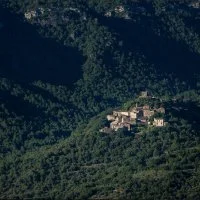
Perched on its limestone spur overlooking the scrubland, the 12th-century feudal castle dominates the plain and offers an unparalleled view of Saint-Mathieu de Tréviers, Pic Saint-Loup, and Hortus.
A historic monument
Originally owned by the County of Melgueil in the 12th century, the castle was confiscated from the Count of Toulouse during the Albigensian Crusade in the 13th century.
It was entrusted by the Pope to the Bishop of Maguelone. During the Wars of Religion, the castle changed hands several times before being gradually abandoned in the 18th century.
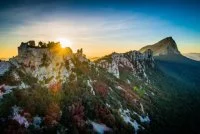
Seemingly emerging from the cliffs, this former fortress is an iconic feature of the Grand Pic Saint-Loup landscape.
An architectural challenge
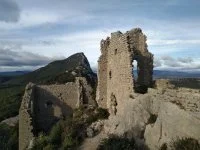
The history and architectural development of the Château de Montferrand demonstrate the ingenuity of its builders, who had to show great skill and resourcefulness to contend with the rugged terrain despite limited technical means.
More than a fortress, the Château de Montferrand bears witness to humankind's ability to adapt to the environment and make the best use of readily available resources.
Even today, the building is so deeply embedded in its limestone setting that it is sometimes difficult to distinguish human creation from the work of nature.
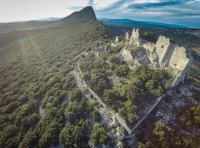
An outstanding panoramic view
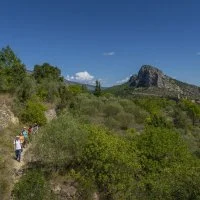
The site is only accessible on foot, via a magnificent hike starting from Saint-Mathieu de Tréviers and following the GR60. Although the castle ruins themselves are currently closed to visitors for reasons of both safety and site preservation, the Château de Montferrand remains an iconic feature of the Grand Pic Saint-Loup landscape and offers an outstanding panoramic view.
As part of this initiative, the Pic Patrimoine association is involved in the Montferrand project and enables those who wish to help preserve the castle, notably through stone-carving workshops.
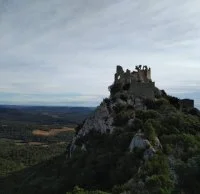
The Château de Montferrand: Historic Monuments
The Château de Montferrand listed as a Historic Monument.
In 2022, it joined the area's 22 other buildings listed as Historic Monuments.
Since 4 April, the Château de Montferrand has been the 8th protected monument in Grand Pic Saint-Loup, alongside the Château de Cambous, the churches of Assas, Claret, St-Martin-de-Londres and Saint-Jean-de-Buèges, and the prehistoric sites of Lebous and Suquet.
This designation reinforces the work of the Communauté de communes and its partners to promote this iconic site and its history.

A history to discover


Practical information
Access to the castle
For safety reasons, access inside the castle walls is temporarily prohibited!
Work is under way to make the site safe and improve its facilities.
By 2027, the secured areas will gradually reopen to the public.
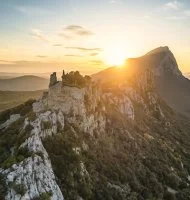
Access trails to Pic Saint-Loup and the Château de Montferrand
- Return route from Cazevieille to Saint-Mathieu-de-Tréviers: Dist. : 14 km - Duration : 5 hrs - Total ascent + : + 230 m
- Return route to Pic Saint-Loup from Saint-Mathieu-de-Tréviers: Dist. : 9 km - Duration : 3 hrs - Total ascent + : + 520 m
- Return route to Pic Saint-Loup from Cazevieille
Dist : 3 km - Duration : 2 hrs - Total ascent + : + 370 m - Return route to the Château de Montferrand from Saint-Mathieu-de-Tréviers: Dist. : 5 km - Duration : 2 hrs - Total ascent + : + 206 m
When crossing Pic Saint-Loup via the GR 60, you are also following the GRP® Tours dans le Grand Pic Saint-Loup, a long-distance regional trail created by the Communauté de communes du Grand Pic Saint-Loup.
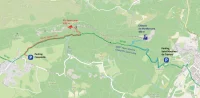
Hiking in the heart of the Pic Saint-Loup massif
The Pic Saint-Loup massif is mainly accessible via the GR 60. The main access point is in Cazevieille. A second access point is located on the Saint-Mathieu-de-Tréviers side, along part of the historic castle trail.
Along this path, information panels cover various themes relating to this part of the massif (history, geology, etc.). After two kilometres, a fork in the path leads either to the summit of Pic Saint-Loup (658 metres) or to the Château de Montferrand (393 metres).
Both locations offer sweeping views across the region as far as the sea. The castle is currently fenced off, but from the outside it is still possible to see its various levels of defence and admire its architecture. The website, documentary film and various information panels along the route recount its history.