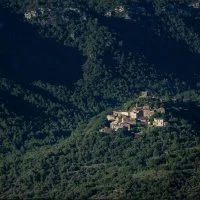
The Legend of Pic Saint-Loup
Dive into the legend of Pic Saint-Loup: three knight brothers, fires on the peaks, and a heroic story that spans the centuries.
The legend of Pic Saint-Loup: mysteries and tales from the past
Pic Saint-Loup is not just a majestic summit of Hérault: it is also a place filled with legends and mysteries. For centuries, its cliffs and ridges have inspired tales and stories, mingling history, local traditions, and popular imagination. Through dramas, thwarted loves, and mysterious events, the legend of Pic Saint-Loup invites one on a fascinating journey through time, where nature and stories meet to captivate the minds of visitors.

In the castle of Esparron lived a mother, Lady Renaude, and her three sons: Loup, Guiral, and Clair. A widow, Lady Renaude soon became unwell. Feeling her end was near, she gathered her three sons...
She declared to them that she would feel at peace leaving the valley if one of them married before her death. She asked them to make a choice among the ladies of the region.
The three brothers were so different! Loup, the eldest, was a passionate knight with chestnut hair. Guiral was robust, tanned, and had jet black eyes. The youngest, Clair, was a young man with blonde hair and delicate manners.
However, their hearts were taken by one and the same young woman, Irène de Rogues. A noble heiress of Count Arnaud de Rogues, Irène was beautiful and an orphan. She was a graceful person, with great qualities of heart, who endured moments of great sorrow alone in her manor.

One night, Loup secretly went to Rogues to confess his love. Very touched by Loup's declaration, Irène asked to reflect for a few days. Guiral presented himself in turn, followed by Clair's visit. For several weeks, Loup, Guiral, and Clair, convinced they had touched Irène's heart, paid her frequent visits every night of the summer of 1095.
Then each hoped to unite secretly with the Lady of their thoughts. Flowers, poems, perfumes, precious stones, many gifts piled at Irène's feet. However, Irène could not make up her mind to choose.
And promised to give her heart to the one who, during the Crusade, would prove to be the bravest and most valiant.
Thus all three set off to war. When the crusade ended, each knight accumulated brilliant feats of arms and acted as perfect heroes.
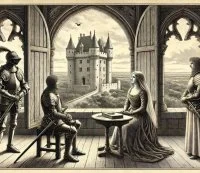
Irène, alas, yearning for news, consumed by love, watched for many long days for the return of the knights from the top of her towers. Time flowed, years passed, still nothing. So much so that her health deteriorated. She believed that without news of the knights, Loup, Guiral, and Clair must have perished in the war.
But the three knights were not dead. When they finally returned, followed by a long line of heavily laden mules with treasures from the East, they were happy. Would the beloved not be waiting at a high window to watch over the countryside? But upon arriving at the walls of the castle of Rogues, a long funeral procession was advancing towards them. Oh mercy!
The three men stopped to kneel down upon discovering Irène's body.
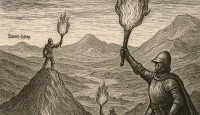
Describing their despair is impossible. Broken, they swore to abandon all their possessions and vowed to withdraw from the world. Nothing could soothe their pain.
Loup spoke and said: « My brothers, the one we loved has returned her beautiful soul to God. From now on, the riches of the universe matter little to us. On these three mountains, which rise around us, we will go to the summit to await the end of an existence that no longer makes sense for us. »
Before parting forever, they agreed that on each anniversary of Irène's death, they would light a great fire to salute each other.
Loup had walked to the castle of Montferrant, on the highest ridge. Each year, they lit a great fire, visible from the plain, which signaled their presence. One year, there were only two braziers left. Then one. Then none. The three hermits were dead.
And in homage to their courage, the peaks were named after them. The one where Guiral lived became Saint-Gural, located near Mont Aigoual. The one where Clair lived became Saint-Clair. At its feet lies the town of Sète.
The one where Loup lived became Saint-Loup.