The Path of the Glassmakers
Legend has it that Saint Louis granted the ruined nobles from the crusades the right to practice the art and science of glassmaking.
The glassmaker gentlemen
From the 13th century until the revolution, the Causse de l’Hortus was an ideal land for these “glassmaker gentlemen.” The numerous oak forests of that time provided the wood, which fueled the furnaces to generate the necessary energy. The manufacturing used lime, sourced from the limestone of the causse, and silica from the Hérault River. The trade routes were not far, and the products were shipped to Sommières, to reach Montpellier and the Mediterranean. The “Path of the Glassmakers” is now used to recount the history of this know-how in these places and its impact far beyond its original causse.
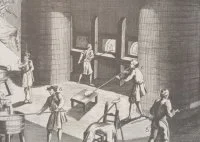
Many glassworks have been inventoried on the Causse de l’Hortus, a vast limestone plateau bounded to the south by the cliffs of Hortus, to the north by the plain of Pompignan, to the west by the London basin, and to the east by the cliffs of Claret and Valfaunès.
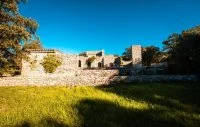
The glassworks of Couloubrines in Ferrières-les-Verreries is today the only dated testimony of this era. The objects created by the glassmaker gentlemen were of great finesse and their talent recognized as far as Majorca. They produced bottles and various containers for winemakers, perfumers, or the faculty of medicine of Montpellier.
Their disappearance after the revolution.
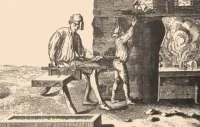
But the activity eventually collapsed. Massive deforestation, the repression of Protestantism to which many of these nobles converted, the replacement of charcoal with that from earth*, which displaced glass production near the coal basins, are some of the reasons. The Revolution of 1789, by abolishing the privilege of the glassmaker gentlemen, marked their disappearance.
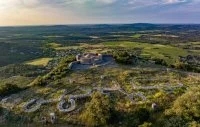
The path of the glassmakers tells of an ancient know-how, but also attests to an identity, to a heritage.
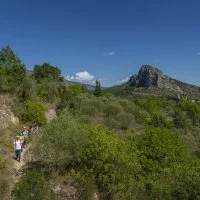
So enjoy the trails that weave through the garrigue to better discover this heritage. In the course of your walks, you will also encounter other human stories that are shared here. Some very ancient, like those of the prehistoric men through the dolmens and the site of the Rocher du Causse. Others that appeared in the Middle Ages with the charcoal workers who made charcoal at various locations. Not to mention, those more recent stories of shepherds who developed lavognes, artificial ponds designed to water the flocks.