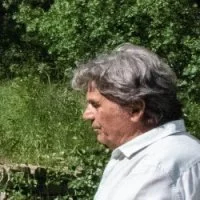
Passionate archaeologist and a key figure at the prehistoric site of Cambous, Luc Jallot has been working for more than forty years in the research, preservation, and transmission of the Neolithic heritage of Grand Pic Saint-Loup.
Can you introduce yourself and tell your story in a few words?
Volunteer archaeologist, archaeology student, manager of scheduled excavations, member of a CNRS team, archaeologist at Afan then at Inrap, lecturer at Paul Valéry University.
How did you arrive in Cambous?
On foot!! To be more serious, my friend knew that I was interested in prehistory and introduced me to the site in 1981.
What is your role on the site today?
I led the resumption of the excavations and I am involved, within the Languedoc Prehistory Society, in its preservation and animation.
Who do you work with daily, within your team in Cambous or with external partners and collaborators, and why are these exchanges important in the life of the site?
With my researcher colleagues, volunteers, archaeology students, and external collaborators. The public also participates in our activities.
What do you like most about your daily work?
The variety of a profession that takes me from Pic Saint-Loup to Africa, from the present to a distant past, makes me a bearer of memory and allows for extraordinary hindsight on the future of humanity.
What makes this prehistoric village unique in your opinion?
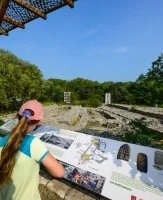
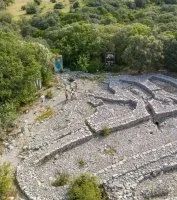
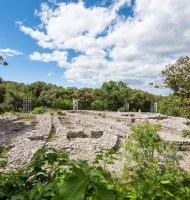
It is the only showcase of living prehistory on an archaeological site in Languedoc. Indeed, Cambous is the only place of experimental archaeology, for scientific purposes, that visitors can participate in. It is an opportunity to raise awareness among young people and their families about the importance of the prehistoric heritage of Hérault and its preservation. It is one of three or four places in Western Europe where one can stroll among the ruins of a Neolithic habitat. These are currently the oldest visible house constructions in France. It is a heritage site and a place of research well-known among European researchers, presented in all archaeology textbooks and recommended in tourist guides like Lonely Planet.
When visitors discover this place, what would you like them to imagine?
That they imagine the sounds, voices, laughter, and bleating of sheep. That they relive the daily life of the inhabitants and feel the harmony of these peaceful societies, still in balance with their environment.
Many people think that archaeology is complicated or reserved for specialists. How do you make it accessible to the general public?
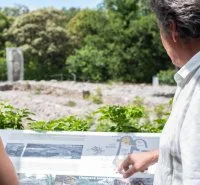
The more an archaeologist knows, the more they provide a discourse understandable by all. Describing how objects tell us about an unknown past can easily be done with simple words. It is very easy to explain the methods of archaeology to people who know what a computer, a mobile phone, an MRI, or AI is. We use technologies much more complicated in daily life than those used by the archaeologist. In reality, our basic tools are our hands and eyes.
Is there a detail of the site or an anecdote that you particularly like to tell visitors?
A detective novel set Cambous and a corpse hidden in one of the site's sinkholes. When the novel was published, people rushed to see that hole in the rock. But, of course, it wasn't real and any sinkhole would do. This anecdote highlights the desire for imagination that resides in everyone. Archaeology can offer this chance for escape.
What projects or ideas would you like to develop to further bring Cambous to life in the coming years?
Make a significant increase possible with the help of experienced mediators: volunteering is no longer enough. Develop the Archaeology Fortnight and the Archaeology Forum in autumn, and encourage the resumption of archaeological excavations. In the long term, reproduce a prehistoric hamlet using experimental methods to recreate the gestures of prehistory.
In your opinion, what continues to fascinate people when they discover prehistory?
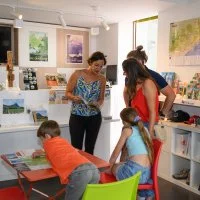
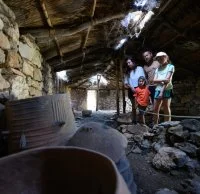
The ruins are quite austere, even though the setting is particularly beautiful. I think it is the direct contact with archaeologists working on the site, as well as the explanations provided, that change the visitor's perspective and fascinate the public. Hence the need to continually improve mediation.
Why is it important to preserve and transmit a place like Cambous?
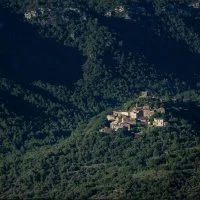
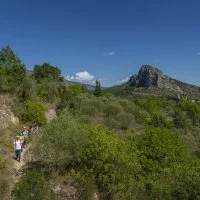
Because we are at the heart of a territory – around Pic Saint-Loup – that is one of the best-preserved in Europe in terms of ecological balances and testimonies of prehistory. The sites from the 3rd millennium BC, especially villages, are in a unique state of preservation in Europe and preserved by the hundreds. Consider that every year some are destroyed. It is an irreversible loss! Cambous is the showcase of this archaeological treasure that deserves to be listed as a UNESCO World Heritage site.
If you had to give just one reason to come and discover Cambous, what would it be?
To immerse oneself in the secret beauty of a place where prehistory is still alive and beckoning us.